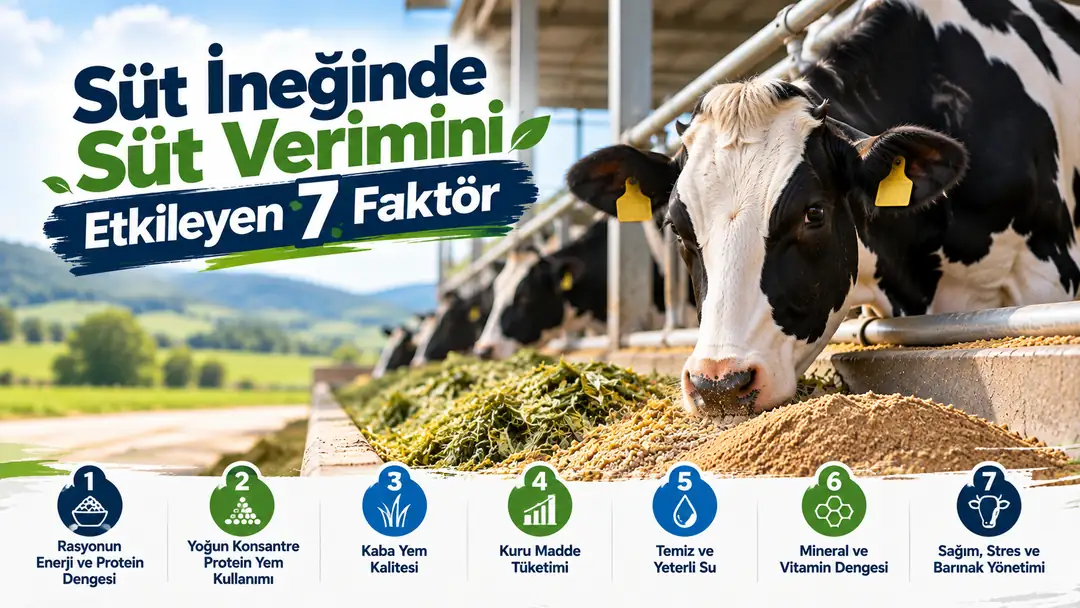
7 Factors Affecting Milk Yield in Dairy Cows
Milk yield depends not only on the cow’s breed or genetic capacity. Care and milking management, along with the daily intake of energy, protein, roughage, water, and mineral balance by the animal, also directly affect milk production.
In enterprises targeting high milk yield, the goal is not just to feed the cow more; it is to provide the nutrients it needs in the right concentration and in a balanced manner.
Here are 7 key factors affecting milk yield:
1. Energy and Protein Balance of the Ration
A dairy cow needs sufficient energy and available protein for milk production. Even if energy is adequate, if protein is insufficient, milk production and especially milk protein can be negatively affected.
Therefore, when preparing a ration, looking only at the crude protein percentage is not sufficient. As much as the amount of protein, its degradability in the rumen, the amount of metabolizable protein, and its balance with energy are also important.
2. Use of Intensive Concentrate Protein Feed
In high-yielding dairy cows, the daily nutrient requirement is quite high. Especially during periods when feed intake struggles to meet the animal’s needs, increasing the nutrient density of the ration gains importance.
At this point, intensive concentrate protein feeds can help introduce higher levels of protein and other necessary nutrients into the ration with a smaller amount of feed.
However, what is important here is not simply increasing the high-protein feed on its own. Concentrate protein feed should be evaluated together with energy sources, roughage, and mineral balance.
3. Roughage Quality
High-quality roughage is of great importance in the dairy cow’s ration.
High-quality corn silage, alfalfa, and other suitable roughages help protect rumen health, maintain rumination activity, and ensure the proper utilization of the ration.
Even the most expensive feed may not deliver the expected performance when used together with low-quality roughage.
4. Dry Matter Intake
More important than how much feed the cow eats daily is how much dry matter it takes in with this feed.
For example, when a feed containing a high amount of water and a feed with a high dry matter ratio are given in equal amounts, the nutrients they provide to the animal will not be the same.
Therefore, when targeting high milk yield, dry matter intake and nutrient density of the ration should be evaluated together.
5. Clean and Adequate Water
Water makes up a significant portion of milk. Therefore, clean and easily accessible water must be available in front of the dairy cow throughout the day.
Especially in hot weather, insufficient water consumption can negatively affect feed intake and consequently milk yield.
Although it may seem simple, clean water is one of the fundamental conditions for high milk yield.
6. Mineral and Vitamin Balance
Minerals such as calcium, phosphorus, magnesium, sodium, and vitamins are important in terms of milk production, immunity, fertility, and overall metabolism.
Especially in high-yielding animals, disregarding the mineral balance can lead to performance losses.
Therefore, when evaluating the ration, not only energy and protein, but mineral and vitamin requirements as well must be taken into consideration.
7. Milking, Stress, and Barn Management
No matter how good the cow’s genetic potential and ration are, poor management can limit milk yield.
Factors such as excessive heat, inadequate ventilation, overcrowded barns, prolonged absence of feed at the feed bunk, irregular milking, and stress can affect the animal’s feed intake and milk production.
Therefore, for high milk yield, good ration + good care + good herd management must be implemented together.
Conclusion: Not More Feed, But More Correct Feeding
Success in milk production is achieved not by putting as much feed as possible in front of the cow, but by creating a balanced and concentrated ration suited to the animal’s needs.
Especially in high-yielding dairy cows, adjusting the protein and energy density of the ration correctly is of great importance. Intensive concentrate protein feeds, when used together with the right roughage and energy sources, can help increase the nutrient density of the ration.
Since each enterprise’s animal breed, live weight, milk yield, lactation period, and roughages used differ, the ration needs to be evaluated specifically for the animal for the most accurate result.