
5 Points That Should Not Be Overlooked in Heifer Management
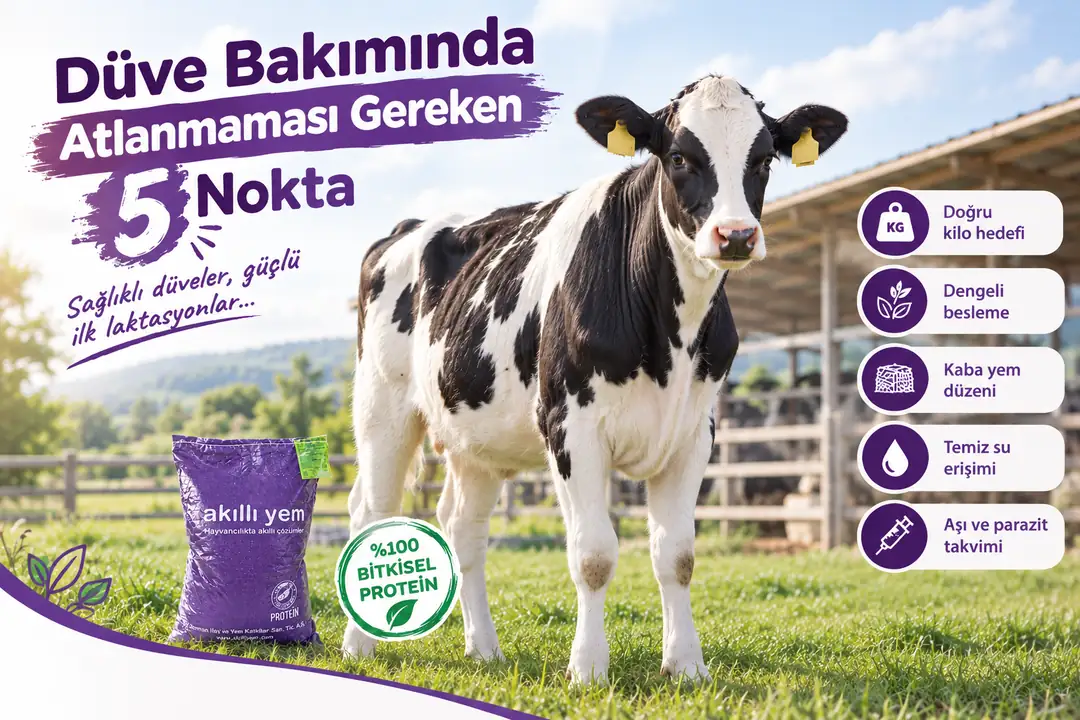
A heifer is an animal that accumulates costs for about two years before starting to produce milk. With the right weight target, balanced feeding, and a proper roughage regime, these two years turn into a strong start to the first lactation.
The least attended pen in the barn is often the heifer pen. They do not give milk, they do not bring in revenue, and eyes are always on the milking parlor and the cows at the feed bunk. However, the animal in that pen is the one that will produce the barn’s milk after eating feed and running up costs for about two years. A mistake made during these two years cannot be easily corrected later.
1. Look at weight, not age
Saying, “She is 14 months old, let’s breed her” is a common mistake. What matters is not the age, but how much the animal weighs at that age. For a Holstein heifer, the target for first service is roughly 370-400 kg. A properly raised heifer reaches this weight in 13-15 months. If you breed an underweight heifer early, the risk of dystocia increases, and the animal has to support both her calf and her own growth at the same time. If your breed is smaller, the target weight decreases accordingly; adjust the figure based on your own breed.
2. Neither too little, nor too much
The target is a live weight gain of 800-900 grams per day. If it falls below this, breeding is delayed, and every delayed month means another month of feed. If you exceed this and make the heifer fat, another problem arises. Especially in the pre-pubertal period, a heifer receiving excess energy will store fat instead of developing mammary tissue, which can reduce first lactation yield. The heifer should not be fat; her skeleton and muscle should be well-developed. Weighing monthly or measuring the heart girth with a tape measure shows where the animal stands relative to the target.
3. Do not neglect roughage and water
While protein and energy are discussed in the heifer ration, roughage often takes a back seat. However, rumen development occurs through roughage. Hammer-milled straw alone is not sufficient for a heifer. Calculate at least 3 kg of chopped straw or hay per heifer per day. Clean water, rock salt, and quality roughage should also be available in front of them all day long. An animal with restricted water intake also reduces its feed intake, and growth silently slows down.
4. Keep animals of the same size in the same pen
If you put heifers of different ages and sizes in the same pen, the smaller ones back down at the feed bunk, and the larger ones eat the feed. After a while, the weights of the animals in the pen diverge from each other. Separate the pens by age and weight, ensuring there is space for every animal at the feed bunk.
5. Do not skip the vaccination and parasite calendar
Internal and external parasite treatments must be applied regularly. The enterotoxaemia (pulpy kidney) vaccine is applied in two doses 21 days apart. If you brought the heifer from outside, plan Pasteurella and IBR vaccines with your veterinarian as well.
Where does Akıllı Yem 38 HP Concentrate Heifer Feed come into play?
In many enterprises, the feed in front of the heifer is barley-corn meal, roughage, and silage. These provide energy but often fall short of the protein needs of a growing heifer. There is a particular need for protein that reaches the small intestine without being degraded in the rumen (bypass protein). Akıllı Yem 38 HP Concentrate Heifer Feed was formulated to close this gap.
- %38 crude protein; consists of soybean meal, canola meal, corn gluten meal, and high-protein cottonseed meal.
- %100 vegetable-based. It does not contain urea, coated urea, ammonium sulfate, bran, sunflower seed hulls, hormones, antibiotics, or ionophores.
- It contains European Union-approved live yeast, mannan-oligosaccharides (MOS), niacin, biotin, organic and inorganic zinc, along with vitamin-mineral support.
- It is used starting from the 6th month until about 1 month before calving.
Since it is a concentrate feed, it is not given alone. It is fed together with your own barley-corn and roughage. Make the transition to the new feed gradually over at least 7 days. Daily sample amounts:
| Age (months) | Live weight (kg) | 38 HP Heifer Feed (g) | Barley-corn meal (kg) | Roughage (kg) | Corn silage (kg) |
| 6-9 | 200-300 | 600 | 2,5 | 5 | 5 |
| 9-12 | 300-400 | 800 | 3 | 5 | 6 |
| 12-16 | 400-500 | 1000 | 3,5 | 5 | 7 |
| 16-23 | 500-600 | 1250 | 4 | 5 | 8 |
These amounts are examples. It is necessary to prepare a farm-specific ration based on roughage quality and the number of animals. Shipping is free throughout Turkey, including for a single 20 kg bag, and orders of 1 ton and above are delivered to your enterprise on pallets.
Conclusion
The money spent on the heifer pen goes away silently, and its return is seen in the milking parlor two years later. A heifer bred according to her weight, raised neither hungry nor fat, and with an adequate supply of roughage and water, gets through her first calving comfortably and starts her first lactation strongly. If you do not know which feed to give and in what quantities, you can consult our team for a farm-specific ration.