
8 Critical Points for Fast and Healthy Weight Gain in Beef Cattle
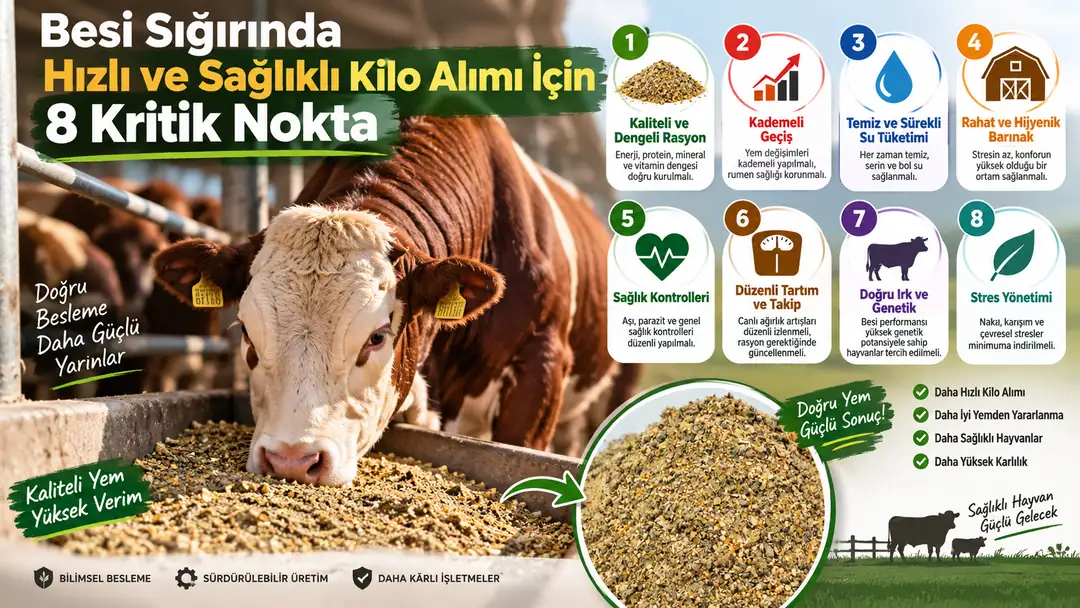
Profit in fattening cattle depends on the balance between the animal’s daily live weight gain and feed cost. In a well-managed farm, a daily live weight gain of 1,2-1,5 kg can be targeted in young male cattle. However, this growth is not the result of a single feed or additive; it is the sum of the right animal, the right ration, a healthy environment, and regular monitoring.
The fattening period generally lasts 5-8 months, and the animal’s needs constantly change during this period. Therefore, successful farms divide the process into four phases: adaptation, transition, growing, and finishing. The figures in this article are general references; they vary depending on breed, age, initial weight, and feed quality.
Overview of the Fattening Process
| Phase | Duration | Roughage / concentrate feed | Crude protein | Daily gain | Main risk |
| 1. Adaptation | 2-3 weeks | Roughage-heavy, very low concentrate feed | %12-13 | Low, variable | Feed refusal, respiratory diseases |
| 2. Transition | 2-3 weeks | Concentrate feed increases gradually, approaches 50:50 | %13-14 | Gradually increases | Acidosis, bloat |
| 3. Growing | 2-4 months | Approximately 50:50 | %13-14 | 1,2-1,5 kg | Sudden feed change, overcrowding |
| 4. Finishing | 6-10 weeks | Concentrate feed high, roughage at least %10-15 | %11-12 | Starts fast, then slows down | Acidosis, rising feed cost |
1. Choose the Right Animal
The outcome of fattening is largely determined before the animal enters the barn. An incorrectly chosen animal will not deliver the expected gain even with the best ration.
- Breed and type: Beef breeds like Charolais, Simmental, and their crosses generally utilize feed better. Dairy-type and low-yield local animals generally have lower growth and carcass yield.
- Age and weight: Young animals grow faster. Initial weight directly affects the fattening period and total cost.
- Health appearance: Bright coat, lively look, dry and clean nose, and firm stance should be sought. Animals with cough, watery eyes, nasal discharge, lameness, and weakness should not be purchased.
- Homogeneous group: Keep animals of close age and weight in the same pen. In mixed-size groups, strong animals dominate the feed bunk, while weak ones fall behind.
- Source: If possible, purchase from a farm with known health records. Animals gathered from different sources increase the risk of disease transmission.
2. Phase 1: Adaptation (First 2-3 Weeks)
Transportation is one of the greatest stresses an animal can experience. A stressed animal does not eat, and an animal that does not eat does not gain weight. The goal of this phase is not rapid growth, but preparing the animal for fattening in a healthy and appetizing manner.
- Feed: Feed primarily with quality roughage (hay, straw, silage). Start concentrate feed in very small amounts and increase it gradually.
- Water: Animals may be dehydrated after transport. Provide immediate access to clean water.
- Health: Keep animals in a separate pen. Complete internal and external parasite treatments, mandatory vaccines in your region (such as foot-and-mouth disease), and veterinary examinations during this period. Separate sick animals from the group.
- Environment: Provide a calm, dry, and draft-free pen. Do not treat animals harshly, reduce noise.
- Observation: Monitor animals individually at the feed bunk every day. Show animals that do not eat, have a cough, or appear listless to a veterinarian without delay. Respiratory diseases are the most common problem after transport.
- Expectation: Weight loss is normal in the first few days. By the end of this phase, all animals should reach full feed intake.
3. Phase 2: Transition (Approximately 2-3 Weeks)
The transition phase is the riskiest period of fattening. Microorganisms in the rumen are accustomed to breaking down fiber in roughage. As the amount of grain increases, starch-digesting microorganisms proliferate, acid production in the rumen increases, and pH drops. If this change is not done slowly, acidosis, bloat, diarrhea, and loss of appetite occur.
How to increase concentrate feed?
Increase concentrate feed not in a single day, but in 5-7 day steps. A general example plan:
- Step 1 (approx. 1 week): Approx. %30 concentrate feed, %70 roughage
- Step 2 (approx. 1 week): Approx. %40 concentrate feed, %60 roughage
- Step 3: Approx. %50 concentrate feed, %50 roughage
Things to consider during transition
- Keep feeding times consistent. Hungry animals eat grain quickly and excessively, which increases the risk of acidosis.
- Do not remove roughage from the ration. Roughage provides rumination and rumen buffering.
- Use buffer substances (such as sodium bicarbonate) and feed additives only upon the recommendation of a veterinarian or nutritionist.
Warning signs
Quitting feed or sudden fluctuations in feed intake, watery and foamy diarrhea, swelling on the left side of the abdomen, decreased rumination, and lameness can be signs of acidosis. If you see these symptoms, return to the previous step and consult a veterinarian.
Note: The same gradual method should be applied when moving from the Growing phase to the Finishing phase. Never change the ration in a single day.
4. Phase 3: Growing (Approximately 2-4 Months)
This period is the investment period of fattening. Skeletal and muscle development take shape here; an animal that grows well gains weight with less feed in the finishing phase. During this period, the animal consumes dry matter of approximately %2-2,5 of its body weight daily, and keeping intake high is essential.
- Roughage / concentrate feed: A ration of around 40:60 is applied.
- Protein: Protein requirements are highest in young and growing animals. Crude protein is planned at around %13-14 levels.
- Energy: Grains such as barley and corn provide energy. Feeding grain ground or cracked facilitates digestion.
- Mineral and vitamin: Add a mineral-vitamin mix that maintains calcium, phosphorus, and salt balance. Salt and minerals can be available free-choice.
- Roughage quality: Prefer quality hay. Moldy, rotten, or soil-contaminated roughage reduces intake and increases disease risk.
- Grouping: Separate animals whose weights diverge into different pens and provide the appropriate ration for each group.
- Expectation: With good management, daily live weight gain can be around 1,3-1,5 kg.
5. Phase 4: Finishing (Last 6-10 Weeks)
The goal in the finishing phase is to complete muscle and fat tissue, bringing the animal to slaughter weight and quality. The ration becomes high-energy, and the concentrate feed ratio peaks.
- Roughage: Even though the concentrate feed ratio is high, do not cut off roughage completely. Leaving at least %10-15 roughage on a dry matter basis protects rumen health.
- Protein: Requirements decrease relatively (approx. %11-12). Unnecessary protein only increases costs.
- Acidosis risk: The risk is highest in this phase. Closely monitor behavior at the feed bunk, fluctuations in feed intake, and manure consistency.
- Feed conversion: Over time, growth slows down, and the amount of feed required for 1 kg of live weight increases. This means every extra kilo becomes more expensive.
How to determine the selling time?
Weigh the animal to calculate daily gain and the feed cost of 1 kg of gain. If the cost of the gain starts to exceed the sales value of the weight, extending feeding is a loss. Also take market prices and demanded weight into account.
6. Keep the Feeding Routine Consistent
Feeding
- Feed at least twice a day, at the same times every day. Regular feeding preserves the balance of rumen microorganisms.
- There should be enough space at the feed bunk for every animal to eat comfortably. Generally, about 50-60 cm of feed bunk length per animal is recommended.
- Keep the feed bunk clean. Regularly collect leftover feed; never feed spoiled and moldy feed.
- Store feed in a dry, moisture-free place protected from rodents. Moldy feed both reduces performance and threatens animal health.
Water
Water is the most neglected feed. An animal that does not drink enough water also reduces its feed intake. Generally, daily water consumption ranges between 30-60 liters per animal, increasing significantly in hot weather.
- Check waterers daily and clean them regularly.
- Provide waterers with a capacity that animals can drink from without waiting in line.
- Prevent water from freezing in winter, and plan capacity according to increased consumption in summer.
7. Weigh, Monitor, Sell on Time
You cannot manage what you do not measure. Regular weighing is the most reliable way to spot problems early and protect profits.
- Weighing frequency: Weigh at the beginning of fattening, then every 3-4 weeks, and before selling. If possible, weigh all animals; if not, weigh a representative sample group.
- Daily gain: Calculated using the formula (New weight – old weight) ÷ number of days. Examine animals falling below the phase target for health and ration issues.
- Feed conversion ratio: The amount of feed consumed for 1 kg of live weight gain. If it is rising, it means costs are getting out of control.
- Records: Write down animal ID, entry weight, weighing dates, feed type and quantity, medication and vaccine information. These records are the most valuable data for the next fattening period.
- If there is no scale: Approximate weight can be estimated by heart girth measurement, but this method is not as precise as a scale.
Daily Checklist
- Did every animal come to the feed bunk, are they consuming feed normally?
- Is there rumination, is the abdomen bloated?
- Is manure consistency normal, is there diarrhea?
- Is there a cough, watery eyes, nasal discharge, lameness?
- Is the water in the waterers clean and sufficient?
- Is there leftover, spoiled feed in the feed bunk?
- Is the bedding dry, is barn ventilation adequate?
Common Mistakes
1. Keeping the adaptation phase short or skipping it entirely
2. Increasing concentrate feed rapidly and cutting roughage
3. Using the same ration in all phases
4. Managing by eye estimation without weighing
5. Delaying sale and inflating feed costs
6. Using banned growth hormones or unconscious medication and additives
7. Neglecting feed bunk and waterer hygiene
Conclusion
Rapid weight gain is not the result of a single feed or additive, but of the right animal, phase-appropriate rations, gradual transitions, a comfortable shelter, and regular monitoring. A farm that plans according to phases, makes slow transitions, and performs regular weighing conducts a fattening operation that is both faster-growing and more profitable.
Stay away from banned growth hormones; use medication and feed additives only upon veterinary recommendation. Working with an animal nutritionist and veterinarian in ration calculation is the safest way.